Panera Bread Allergen Menu 2026: Food Allergy Guide
The Panera Bread allergen menu helps customers check ingredient-related allergen information before choosing breakfast, sandwiches, soups, salads, bakery items, or drinks. Panera warns that menus and ingredients can vary by bakery-café and that it cannot guarantee any menu item is free of allergens because common allergens are handled throughout its supply chain and cafés.
Important: An allergen chart is a reference tool, not a guarantee that a dish is safe for someone with a food allergy. Check the current information for your specific café and ask a manager to verify ingredients if anything is unclear.
Which Allergens Does Panera Bread List?
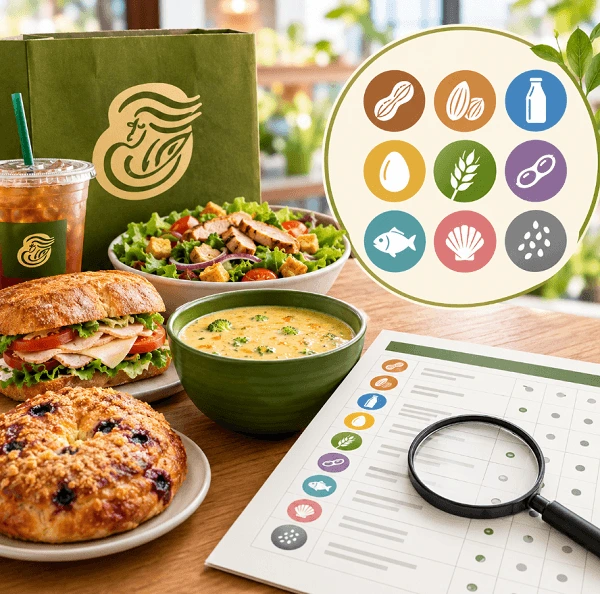
Federal food labeling rules single out nine foods as major allergens. These categories are useful when reviewing Panera’s allergen list, although individual ingredients and preparation conditions still need to be checked.
| Major allergen | What to look for |
| Milk | Milk, cream, cheese, butter, and milk-derived ingredients |
| Egg | Whole eggs, egg whites, and egg-based ingredients |
| Wheat | Wheat flour, bread, pasta, and wheat-derived ingredients |
| Soy | Soybeans and soy-derived ingredients |
| Sesame | Sesame seeds, tahini, and sesame-derived ingredients |
| Peanuts | Peanuts and peanut-derived ingredients |
| Tree nuts | Almonds, walnuts, pecans, and other tree nuts |
| Fish | Fish ingredients and fish-derived products |
| Crustacean shellfish | Shrimp, crab, lobster, and related crustaceans |
Panera Bread Allergen Menu Information by Category
Panera sorts its chart by menu category, and the sections below follow the same order.
Jump to Category
Bakery
If you came for the Panera bakery allergen menu, start with these points:
Yes for Wheat, Milk, Soy and Egg
Sesame is in more bagels than you’d guess
Plain, Blueberry and Cinnamon Swirl & Raisin all show Yes for sesame, not just the Everything and Sesame bagels.
Flagged for Tree Nuts
The croissant carries six flags
They are wheat, tree nuts, milk, soy, egg and sesame, and only wheat and milk are Yes.
Peanuts, May Contain Only
No bagel, bread or baked goods list peanuts as a Yes.
Breakfast
The Panera breakfast allergen menu is easiest to read by comparing builds. Egg & Cheese on Croissant has six flags, while the same sandwich on Artisan Ciabatta has four, because the bread changes the result.
Breakfast Sandwiches (flags change with the bread)
Single-flag Items
No Flags at All
Soups, Mac and Drinks
For the Panera Bread soup allergen menu, every soup on the current list carries at least one flag. That is the core of the Panera soup allergen picture.
Soups
Mac and Bread Bowl, also Flagged
Ten Vegetable Soup does not appear on the current chart or on the June 17 chart. If a café says it has it, ask for that café’s ingredient statement.
Drinks with no Flags
Drinks With a Single Flag
Drinks with Six Flags, mostly May Contain
Dairy, Egg and Soy: What the Chart Lets You Rule Out
For Panera allergen menu dairy questions, the chart has a milk column, not a dairy-free label. These items show no milk flag:
That is the practical answer to Panera’s allergen menu for dairy-free, with one caution: no milk flag is not the same as vegan. The same items, except the croissant (which isn’t on that list anyway), show no egg flag,
Salads With a Separate Nut-free Version Listed
Why Does Panera also Identify Gluten Sources?
Wheat and gluten are related but not interchangeable terms. Wheat is one of the nine major allergens, while gluten is a group of proteins found in wheat, rye, barley, and related grains.
Panera’s allergen guide identifies wheat and also indicates gluten sources. This distinction matters because:
- A person with a wheat allergy needs to consider wheat and wheat-derived ingredients.
- Someone with celiac disease needs to avoid gluten and account for cross-contact.
- Someone with non-celiac gluten sensitivity may have different dietary requirements.
Do not assume that an item without listed wheat is gluten-free. Check the relevant ingredient information and preparation conditions. For more background, see the FDA’s food-allergy information.
How to Read the Panera Bread Allergen Menu Chart?
The Panera allergen chart lists each menu item in a row and each allergen in a column. Find your item, then read your allergen’s column. Don’t guess from the dish name.
What “Yes” means
The allergen is flagged for that item. A “Yes” on one soup tells you nothing about another soup, so check each item on its own.
What “May Contain” means
The allergen isn’t a listed ingredient, but the item could pick it up through shared production. Treat it as a real warning. With a severe allergy, ask a café manager to check the current ingredient information.
What “No Major Allergens Present” means
None of the nine major allergens are flagged for that item. It does not mean allergen-free. Panera doesn’t promise that any menu item is allergen-free, since common allergens move through its supply chain and cafés and the equipment is shared.
What a blank cell means
Nothing is flagged in that column for that item. It isn’t a safety guarantee, so don’t fill in gaps by guessing. If an entry is unclear, ask the café.
How to Check Panera Menu Items for a Specific Allergy?
Start with the allergen you avoid. Find your item on the Panera allergen list, read that one column, then open the item’s ingredient information for your café.
Can You Customize a Panera Order to Avoid an Allergen?
You can customize an order, but the chart won’t tell you the new order is safe. Panera warns that changing your order online won’t change the allergen information shown for it.
Take a sandwich with cheese. Dropping the cheese changes one ingredient. It says nothing about the bread, the sauce or how the sandwich is made. Before you order a modified item:
- Check the allergen flags for the original item.
- Tell the staff it’s an allergy, not a preference.
- Ask the manager to confirm the changed ingredients and how it will be prepared.
- If you can’t get a clear answer, skip it.
Cross-Contact at Panera Bread
Cross-contact happens when traces of an allergen end up in a food that doesn’t contain it as an ingredient. A shared grill, a reused utensil, an unwiped counter or a glove that touched another food can all carry it over.
It is different from an allergen being an intentional ingredient in a recipe. Panera says that common allergens are handled throughout its supply chain and bakery-cafés and that shared equipment prevents it from guaranteeing allergen-free menu items.
Why Shared Preparation Equipment Matters?
A dish’s listed ingredients do not tell the entire story about how it is prepared. Even when a particular ingredient is not intentionally included, the preparation environment may create additional uncertainty.
This is especially relevant to people with allergies that can cause serious reactions. The chart is a good starting point, but it shouldn’t be your only check.
What to Ask the Café Manager?
Explain the specific allergy and ask the manager to:
Panera does not guarantee that its menu items are allergen-free. If your concern cannot be adequately addressed, do not assume that changing the order will eliminate the risk.
How to Verify Allergen Information Before Ordering?
Use this checklist whenever you are considering a Panera item for someone with a food allergy.
Before Ordering
- Open Panera’s official allergen and nutrition page.
- Confirm that the allergen guide is the latest available edition.
- Find the exact item, including the correct version or serving.
- Check every allergen category relevant to the person eating.
- Review any planned substitutions or ingredient removals.
- Ask the café manager to verify unclear ingredients and preparation concerns.
- Consider Panera’s shared-equipment warning before deciding whether to order.
If Ordering Online
Do not treat the removal of an ingredient from an online order as proof that the modified item is free of that allergen. Panera warns that customization does not reliably update its allergen identification. If you cannot obtain enough information to make an informed decision, choose not to order that item.
Frequently Asked Questions
Conclusion
The Panera Bread allergen menu is a starting point for checking ingredients, not a promise that any dish is free from allergens. The most reliable approach is to use the current official guide, verify the exact item at your intended café, and ask a manager about ingredient changes and cross-contact.
When the information is incomplete or a preparation concern cannot be resolved, avoid making assumptions. For someone managing a serious food allergy, a clear understanding of the limits is more useful than an unsupported list of supposedly safe menu choices.